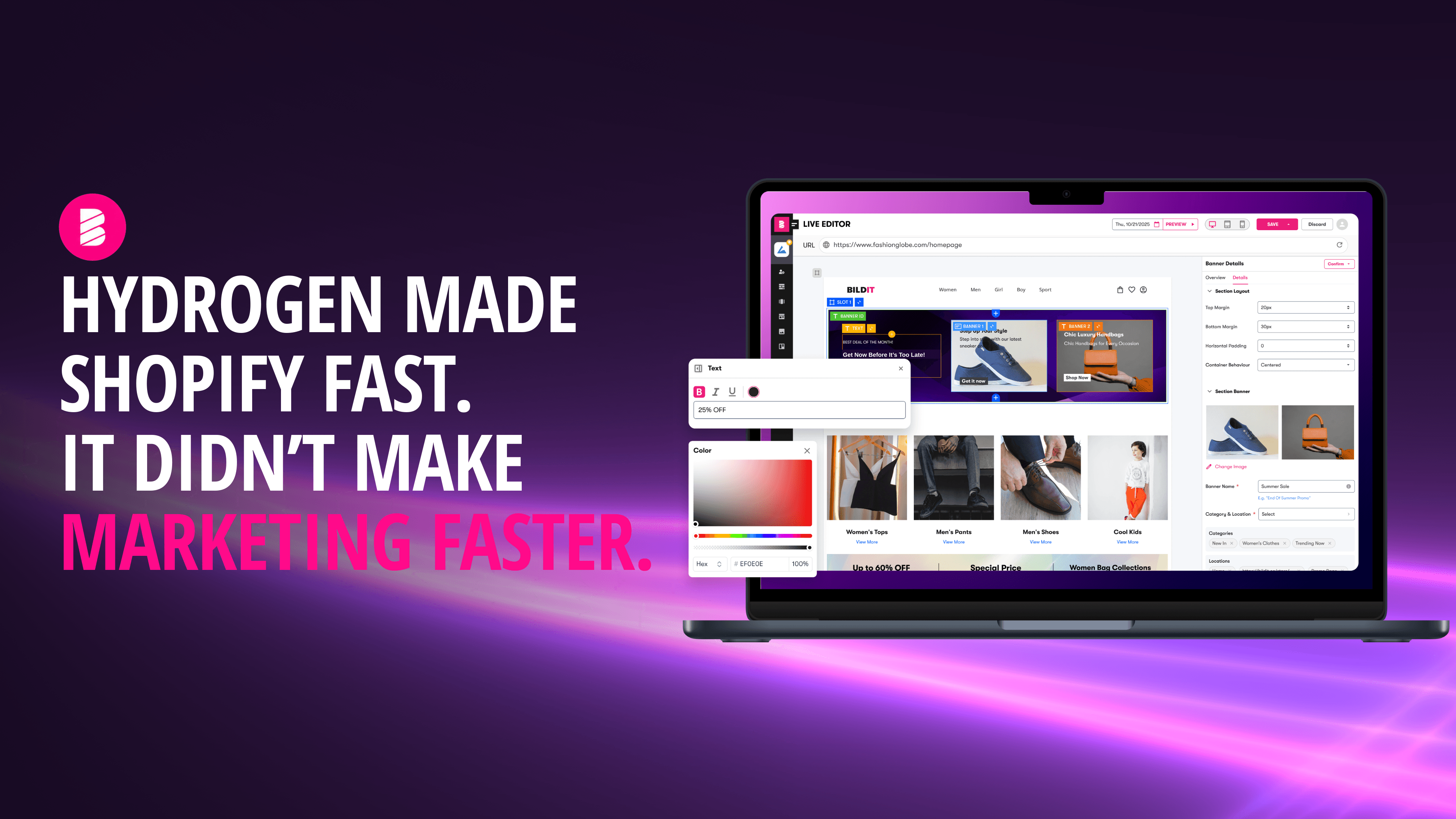
Hydrogen Made Shopify Fast. It Didn't Make Marketing Faster.
Key takeaways
- Shopify Hydrogen is a React framework, not a content system. It solves rendering performance; it says nothing about who edits a homepage banner after launch.
- Without something else in the stack, every content or checkout change on a Hydrogen storefront still routes through a developer and a deploy — the exact bottleneck headless architecture was supposed to remove.
- Real Hydrogen builds show what's possible when performance and merchandising both work: Nour Hammour's migration produced a 63% lift in conversion rate and 128% year-over-year sales growth.
- A visual content layer — like BILDIT's Visual Experience Engine — sits on top of a Hydrogen build so marketers can edit content and checkout messaging directly, while engineering keeps the typed components and review process intact.
Ask a Shopify Plus engineering lead what they like about Hydrogen and you'll hear about server-side rendering, edge caching on Oxygen, and Core Web Vitals scores that make their Liquid-theme days look embarrassing. Ask their marketing counterpart the same question a month after launch, and you'll usually get a longer pause. The storefront is fast. Changing anything on it is not.
That gap is not a Hydrogen bug. It is what happens whenever a team solves a performance problem without also solving the operational one sitting right behind it.
What Hydrogen Actually Solves — and What It Doesn't
Hydrogen is Shopify's own React-based framework for building custom storefronts against the Storefront API, with Oxygen as the purpose-built hosting layer underneath it — a Cloudflare Workers–based edge runtime that ships alongside every Shopify plan at no extra hosting cost. As of the 2026 release line, Hydrogen runs on React Router v7 (the successor to Remix, which it was originally built on), uses Vite for the build tooling, and follows Shopify's own calendar-versioning scheme rather than traditional semver. None of that is marketing language; it's the actual stack, and it's a reasonable one — Hydrogen and Oxygen are free to run on any Shopify plan, with the real cost sitting in the build itself, which typically runs anywhere from roughly €150,000 to €700,000+ depending on scope, team, and how much of the catalog and logic needs custom work.
What Hydrogen gives you, in plain terms, is a fast, fully controllable frontend decoupled from Shopify's theme layer. What it doesn't give you is a way for a merchandiser to swap a hero banner, launch a flash-sale message, or reorder a homepage module without a pull request. Liquid themes had this built in, clumsily — theme editor, sections, drag-and-drop blocks. Hydrogen, being a developer framework rather than a CMS, has no equivalent unless a team builds or buys one.
The Part Nobody Puts in the Migration Deck
Most Hydrogen migration conversations center on performance, SEO, and design freedom. Almost none of them start with “who edits this after we ship it”, and that question doesn't surface until three weeks post-launch, when marketing files its first ticket to change a promo banner and discovers the answer is: whoever is available on the engineering team, whenever the next release window opens.
This is the same operational bottleneck headless architecture was supposed to eliminate, just relocated. On a monolithic Liquid theme, content changes were slow because the theme was hard to work with. On a Hydrogen storefront, content changes are slow because there's no content layer at all — just components, props, and a codebase that treats every text change the same way it treats a new feature: through code review and a release.
What Changes When a Visual Layer Sits on Top
This is the specific problem BILDIT — the company behind the Visual Experience Engine — built its product around. The distinction matters: BILDIT is the vendor and the team behind the SDK and integrations; the Visual Experience Engine is the actual layer that gets wired into a Hydrogen storefront's components.
In practice, that layer does three specific things a bare Hydrogen build doesn't:
Inline visual editing of the components that already exist. Rather than replacing Hydrogen's component architecture, the Visual Experience Engine wraps defined slots inside it — a hero, a promo module, a product grid header — so a marketer can click into the live storefront, change copy or swap an image, and see exactly what will render, before anything ships.
Scheduling and publishing without a deploy. A holiday promotion, a flash sale, a regional campaign — these get scheduled against the calendar and go live automatically, without occupying an engineering sprint or a release window.
Live preview against the real render, not a mockup. Because the underlying storefront is still server-rendered through Hydrogen, preview reflects the actual SSR output the customer will see, not an approximation built in a separate editor.
None of this touches Hydrogen's rendering model or its edge performance. That's the point — the Visual Experience Engine sits at the content layer, above the framework, not inside it.
A Realistic Week: Shipping a Flash Sale Two Ways
Picture a mid-size Shopify Plus brand running a bare Hydrogen storefront, and marketing needs a 48-hour flash-sale banner live by Friday morning.
Without a content layer: the brief lands with engineering Monday, behind two feature tickets and a bug fix already in the sprint. A developer picks it up Wednesday, hardcodes the banner copy into the relevant component, opens a pull request, waits on review, merges, and triggers a deploy. If the sale needs to end automatically at a set time, someone either schedules a second deploy to pull it down or sets a reminder to do it by hand. Best case, this ships Thursday afternoon — a day later than planned, and it consumed roughly half a day of engineering time that had nothing to do with the actual product roadmap.
With a visual layer in place: marketing opens the live editor Monday afternoon, edits the existing promo slot directly, previews it against the real server-rendered storefront, and schedules it to go live Friday at midnight and expire Sunday at midnight without anyone touching it again afterward. No pull request. No deploy. No engineering time spent on a banner.
The gap isn't dramatic in any single instance. It's the accumulation across a full marketing calendar that matters. A brand running weekly promotions, seasonal campaigns, and landing-page tests on top of a bare Hydrogen build is effectively routing its entire merchandising cadence through the same release process as its actual software changes. That's a workable model for a handful of changes a quarter. It breaks down fast once campaign velocity looks anything like what a modern ecommerce marketing calendar actually demands.
Checkout: What's Actually Editable, and Through What
Checkout is where this question gets sharper, because Shopify checkout on Hydrogen isn't a blank canvas — it's a tightly governed surface with its own extension model, and conflating “customizable” with “wide open” is a fast way to plan a project that Shopify's own architecture won't allow.
Shopify defines a specific set of technologies for customizing checkout, each scoped to a different kind of change:
- Checkout UI extensions: Adds custom UI or content into checkout and the order status page. Typical use: Banners, upsell modules, delivery instructions, trust badges.
- Shopify Functions: Replaces backend logic — discounts, shipping, payment method visibility. Typical use: Custom discount rules, hiding a payment option for certain carts.
- GraphQL Admin API — checkout branding: Look-and-feel — colors, typography, header and footer branding. Typical use: Matching checkout to a brand refresh (Shopify Plus only).
- Web pixel extensions: Tracks customer behavior through checkout. Typical use: Analytics, attribution.
None of those are things a visual content layer replaces — they're Shopify's own extension surfaces, and any serious Hydrogen build should be using them directly. What the Visual Experience Engine adds sits one layer up: the content inside those checkout UI extensions — the promo message in a banner block, the countdown copy on a shipping threshold, the seasonal messaging in the order-status page — becomes something marketing can schedule and edit without a redeploy, while the extension code itself stays exactly where it belongs, in engineering's repository and review process.
Case in Point: Nour Hammour
Nour Hammour, a leather-outerwear brand, rebuilt its storefront on Hydrogen after evaluating the usual concerns around headless complexity and development overhead. Tom Mittlener, senior developer at the agency Commerce-UI, has said the appeal of Hydrogen for that build came down to how much of the commerce logic — cart, pagination, search, product and collection data fetching, SEO schema generation — came pre-built, cutting months off custom development.
The results, reported by Commerce-UI: a 63% increase in conversion rate and a 128% year-over-year increase in sales following the migration, with the build deployed on Oxygen for global edge distribution. Ben Sehl, Product Lead at Shopify, has cited Commerce-UI's work — including this build — as representative of what a well-executed Hydrogen storefront can deliver.
What that case study doesn't detail, and what most Hydrogen showcases skip entirely, is the operating model after go-live: who owns the next hundred content changes, and how many of them require touching the same codebase that shipped the original build. That's the question a visual layer is answering, not the one the performance numbers answer.
Nour Hammour isn't an outlier build, either — Hydrogen storefronts now range from independent DTC brands to musician Lady Gaga's official commerce site, which points to the same conclusion from a different angle: the framework itself is proven at very different scales. The operational question — who maintains the content on top of it once the launch excitement fades — is the same regardless of how well-known the brand is.
Where Hydrogen — and a Visual Layer — Isn't the Right Call
Worth saying plainly: Hydrogen is not the correct choice for every Shopify store, and neither is adding a visual content layer on top of one. A store running comfortably on a well-built Liquid theme, with conversion performance that isn't actually bottlenecked by the platform, gains little from a Hydrogen rebuild beyond cost and migration risk. Brands with eight or more Shopify apps hooked into Liquid template extensions face real integration rework on a Hydrogen migration, since each app needs a direct API integration and some simply don't expose one. And a team without dedicated front-end engineering capacity will struggle to maintain a custom React storefront regardless of what content tooling sits on top of it — a visual layer speeds up marketing's side of the workflow, but it doesn't remove the need for engineers to own the underlying codebase.
The decision to go headless should be driven by an actual constraint Liquid can't solve — a personalization need, a multi-brand storefront off one Shopify backend, a genuinely custom checkout flow. If that constraint doesn't exist yet, neither does the case for Hydrogen.
Engineering Keeps the Guardrails
For teams where Hydrogen is the right call, the operating model that tends to work looks the same regardless of vendor: engineering defines the slots, the validation rules, and the design-system constraints in code, reviewed through the normal CI pipeline. Marketing then works inside those defined boundaries — editing content, not structure. Nothing marketing publishes can introduce an untyped prop or break a component contract, because the contract was never exposed to them in the first place. That division is what keeps a visual layer from turning into the kind of “marketing broke the build” incident that makes engineering teams reasonably skeptical of any tool promising to let non-developers touch production.
FAQ
What is Shopify Hydrogen used for?
Hydrogen is Shopify's official React-based framework for building fully custom, headless storefronts against the Storefront API, typically hosted on Shopify's own Oxygen edge platform.
Can marketers edit a Hydrogen storefront without a developer?
Not out of the box — Hydrogen is a code framework with no built-in content editor. A visual content layer, such as BILDIT's Visual Experience Engine, adds that capability by wrapping defined components in editable, schedulable slots without altering the underlying codebase.
Does adding a visual layer slow down Hydrogen's Core Web Vitals?
No, when implemented correctly — the layer operates at the content level while Hydrogen's server-side rendering and Oxygen's edge caching continue to handle delivery exactly as they would in a bare Hydrogen build.
Is BILDIT compatible with Shopify Hydrogen and Oxygen?
Yes. The Visual Experience Engine integrates with Hydrogen storefronts through BILDIT's SDK, working alongside Oxygen hosting rather than replacing it.
What's the difference between checkout UI extensions and a visual content layer?
Checkout UI extensions are Shopify's own developer-built extension points for adding functionality to checkout. A visual content layer doesn't replace that system — it makes the content living inside those extensions editable by marketing without a redeploy.
BILDIT builds the Visual Experience Engine specifically for teams running Next.js and Shopify Hydrogen storefronts who don't want every campaign to require an engineering ticket. Get a 14 day free trial or book a technical demo to see it wired into a Hydrogen build.